
The Ford Paddle Shifter Upgrade Guide
How a paddle shifter upgrade works on an automatic Ford: paddle types, the wiring behind the wheel, fitment checks and what to test once the wheel is back on.
Read More →Guide · 10/19/2026
A workshop routine for a Ford rim in Alcantara and carbon fiber: brush, damp wipe, blot and dry, plus the cleaners that quietly ruin a pile or a satin clear coat.
Ranch dust, job-site grit and a dog that rides shotgun all leave marks on a Ford rim. The Alcantara grips trap that grit in their pile. Carbon trim holds it on a clear coat, and one routine for both will ruin one of them.
The method below is the one our workshop uses on F-150, Bronco and Mustang wheels. It assumes no steam, no pressure washer and nothing stronger than a pH-neutral cleaner.
Hands do most of the damage. Palm oil, hand cream and sunblock move onto the rim every time you grip it. No other surface in the cab is touched as often.
Trucks add two more sources. Road dust comes through an open window on gravel and settles deep in the grips. Work gloves carry grit and metal dust that scuffs a stitched seam like fine sandpaper.
There is a third pattern we see on Bronco and F-150 wheels. A dry cloth pushed across a dusty rim leaves a pale smear. The dust has been pressed into the fibre instead of lifted off it.
Suede is split leather. Alcantara is a non-woven microfiber with a brushed pile, and the pile is the part that matters when you clean it.
That pile holds oil the way a carpet holds sand. A wet cloth drives the oil deeper, and a foaming all-purpose cleaner leaves detergent behind that dries into a stiff patch.
So the rules stay modest. Lift the dry soil first, dissolve the oil with as little liquid as possible, then blot the surface and let the pile reset.
Set aside twenty minutes and two microfiber cloths, one damp and one dry. A soft upholstery brush is the third tool, and it does more than either cloth.
Anyone searching Ford clean alcantara steering wheel has usually just found a shiny grey patch on the grips. The shine is compacted pile, and the brush in step one is what lifts it.
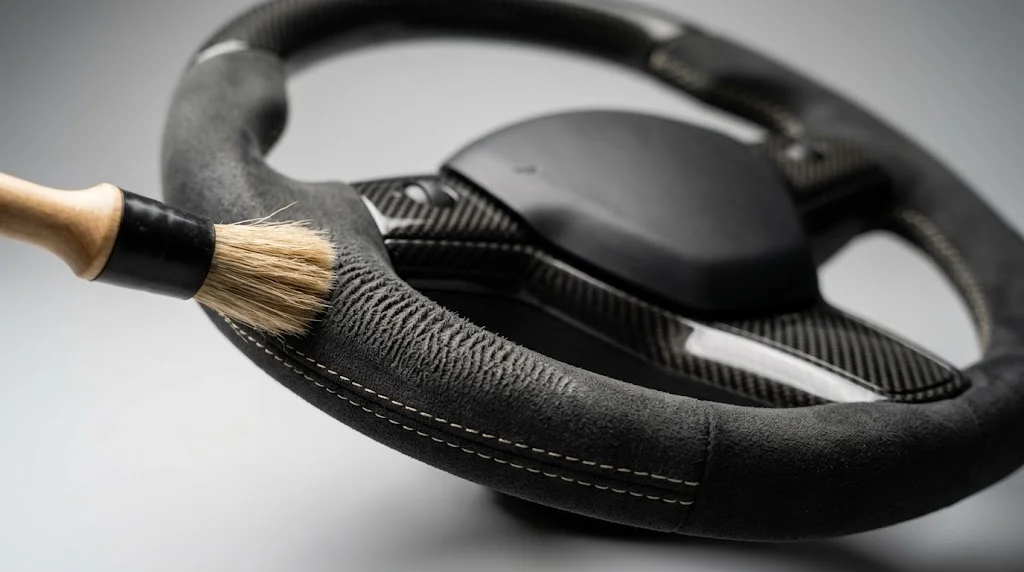
In practice the answer is short. Brush dry, wipe barely damp, blot, then air dry.
Clear-coated carbon is a hard surface, so the method inverts. Less water, no brush, and nothing abrasive at any stage.
Two habits ruin a carbon rim. The first is a polish with grit in it, which dulls a matte finish in patches. The second is a silicone dressing, which leaves a film that attracts dust and never fully comes off.
A damp microfiber and an immediate dry are enough for fingerprints. For sticky residue, put a plain interior cleaner on the cloth rather than on the rim.
Most of these wheels carry more than one material, so the table below is worth keeping near the tool box.
| Surface | What to use | What to avoid |
|---|---|---|
| Alcantara grips | Soft brush, pH-neutral foam, dry blot | Soaking wet cloths, detergent, heat |
| Gloss carbon | Damp microfiber, plain interior cleaner | Grit polish, silicone shine |
| Matte carbon | Damp microfiber, dry straight away | Any polish, scouring pad |
| Perforated leather | Soft brush, leather cleaner | Flooding the perforations |
| Stitching | Damp cloth, soft toothbrush | Bleach, dye-heavy cleaners |
A matte carbon rim is the one owners most often spoil. One pass with a gloss polish leaves a permanent bright patch under the light.
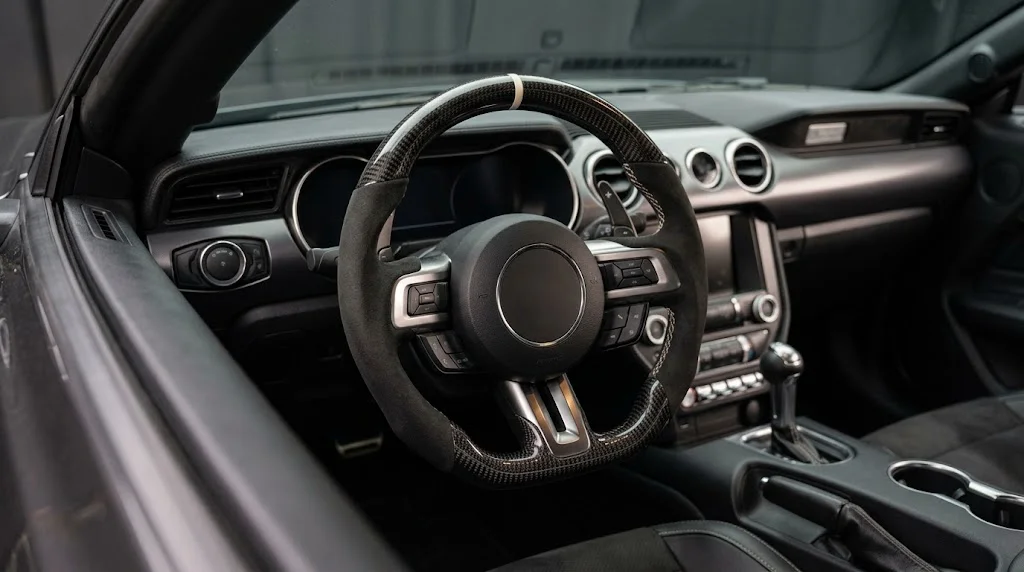
Five things account for most of the damage we see on wheels sent back for a re-trim.
Insect repellent deserves its own line. Products built around DEET soften plastic and some clear coats, and a hand still wet with one should not touch the rim.
The seasons change what lands on the wheel. From May onward, sunblock is the main contaminant on a truck with the windows down. It builds up at the top of the rim, where the sun lands.
Winter brings road salt in on gloves. Salt turns abrasive once it dries, so a quick wipe before the drive home saves a deep clean in spring.
A cabin parked in the sun gets hot enough to soften a dressing or a cheap conditioner. A hot cabin is one more reason to keep both off the rim entirely.
A second-hand wheel arrives with somebody else's habits on it. Clean it on the bench before it goes near the column, while every side is reachable. This is also where the Ford clean alcantara steering wheel question is hardest, because the soil has had years to settle.
Start with the brush and a dry pass, then work around the rim in sections. Change the water once, because the first pass lifts most of the soil.
Look at the stitching while the rim dries. Frayed thread at the top is wear rather than dirt, and no cleaner will put it back.
Three problems do not come out with soap. Pilling is fibre rubbed into small balls, and it can be shaved once with a fabric comb. Shine is compacted pile, and a brush usually lifts it.
Dye transfer is the third. Dark jeans and a leather jacket can leave colour in the pile, and once that colour has set, a re-trim is the honest answer.
The fourth case is wear through the pile at the top of the rim, where a hand rests on every drive. This is the point where a Ford clean alcantara steering wheel routine turns into a decision about materials rather than a cleaning job.
If a cleaning question becomes an order, four details decide the build. The model and year come first, then the trim, then two photographs.
Button pods and airbag covers differ between trims that share a badge. A photograph settles that faster than a paragraph of description. Add the VIN as well, because it narrows the option list to what the factory actually built.
A re-trim keeps every electronic part that was on the truck, and that is the case where a workshop visit may not be needed. The clock spring, the button pods and the airbag all go back as they came off.
A newly made core can carry a different module, and then the truck may need to learn what is fitted. Coding is a possible step in that case, not a promise in either direction, and the VIN plus photographs usually settle it.
Heated rims cause the most returns. The heating mat adds thickness under the covering, and a pattern cut for a plain rim will not sit flat over it.
A heated rim finished in Alcantara is a second issue. Heat and trapped moisture are hard on any pile, so the covering should follow the mat rather than the other way round.
A button frame from another trim is the third. It looks identical in a photograph and differs at the connector, which shows up as dead buttons after fitting.
It needs a pH-neutral one. A dedicated Alcantara cleaner is convenient, and mild soap in water does the same job on a rim that is only dusty.
Only if it carries no solvent and no silicone. A plain interior wipe is safer, and a damp microfiber is safer still.
Monthly on a daily truck, and after any dusty week. Treat Ford clean alcantara steering wheel work as routine maintenance rather than a spring event.
Usually not. Shine is compacted pile, and a soft brush after a light clean brings most of the nap back up.
Not if the rim is left to air dry. Water forced into the mat is the risk, which is why the cloth stays barely damp.
Yes. Any core we build can be covered again in Alcantara, leather or carbon, and the frame stays with the truck.
Wipe the cover with a damp cloth and nothing else. Solvents on an airbag cover are a poor idea for reasons that go well beyond appearance.
Every wheel that leaves our Guangzhou workshop was built for one vehicle, after the order arrived. Nothing here sits finished on a shelf waiting for a badge to match.
Thirteen or more years of design, engineering and production sit behind the patterns we hold, from Raptor frames to Focus button pods. Covering, stitch colour and rim shape stay your decision, and each one is checked against your VIN before a pattern is cut.
Orders ship tracked worldwide with a three-year warranty and thirty days for a return through an RMA request. The person who answers your question about a cleaner is the person who built the rim.
Three pages here pick up where the cleaning cloth stops. The materials comparison weighs carbon against Alcantara and leather over a year of use. The gloss and matte guide explains why a satin finish needs different handling from a polished one. The Mustang, F-150 and Raptor guide covers the frames and trims behind these wheels.
For the range itself, the shop lists every build. The Ford brand page, the F-150 Raptor page and the Bronco page show which frames each truck uses.
Before you buy a cleaner or a new rim, take a daylight photograph of the worn area and send it over. We will tell you whether the pile can be lifted or whether a re-trim is the better spend. The Ford clean alcantara steering wheel question then gets an answer for your own truck, not for trucks in general.
Two builds suit this work. The flat-bottom carbon and Alcantara wheel for the Focus is the one to study if the grips are the part you care about. The Bronco wheel in perforated Nappa leather shows the same idea for a truck that sees more mud than dust.
Background reading sits in the installation guide, the FAQ and the about page. Fitment and delivery questions can go to the contact page or the inquiry form. The shipping policy and return policy set out the commercial side. The federal warranty standard sits in 15 U.S.C. 2304, with the related interpretations in 16 CFR Part 700.
How a paddle shifter upgrade works on an automatic Ford: paddle types, the wiring behind the wheel, fitment checks and what to test once the wheel is back on.
Read More →How to measure a Ford steering wheel at home: the three figures we need, where to place the tape, and the photographs that settle the fitment check before an order.
Read More →How a flat bottom and a round rim differ on a Ford: which shape suits an F-150, Raptor, Mustang, Focus or Bronco, and what each one changes at the wheel.
Read More →