
The Ford Alcantara and Carbon Fiber Cleaning Guide
A workshop routine for a Ford rim in Alcantara and carbon fiber: brush, damp wipe, blot and dry, plus the cleaners that quietly ruin a pile or a satin clear coat.
Read More →Guide · 10/18/2026
How a paddle shifter upgrade works on an automatic Ford: paddle types, the wiring behind the wheel, fitment checks and what to test once the wheel is back on.
A paddle that clicks cleanly changes how an automatic Ford feels on a back road. The factory plastic tabs work, but they sit close to the rim and give little feedback. A Ford paddle shifter upgrade fixes both, and it can be done without changing the wheel itself.
The work divides into two questions. Does the car already have paddles, and does the new paddle fit the frame behind the airbag? Everything else follows from those two answers.
Paddles arrive with the automatic gearbox, not with the badge. A Mustang with the ten-speed automatic usually has them, and the same car with a manual has nothing to upgrade.
F-150 and Focus automatics vary by year and trim. The table below shows what we ask about before quoting.
| Ford | Typical setup | What to confirm |
|---|---|---|
| Mustang, automatic | Paddles behind the rim on most later cars | The paddle type and the wheel frame |
| F-150, automatic | Trim dependent, often with SelectShift | Whether paddles are fitted, and their shape |
| Focus, automatic | Model and year dependent | The frame behind the airbag |
| Bronco, automatic | Trim dependent | Confirm before ordering |
Manual cars sit outside this conversation. There is no paddle to replace, and the money is better spent on the rim surface instead.
The paddle sits on a mount behind the spoke. A longer paddle brings the tip closer to your fingers, so the shift comes without leaving the rim.
A metal paddle also changes the feel. The click is firmer, and the surface does not flex under a quick pull. That matters most on a downshift into a corner.
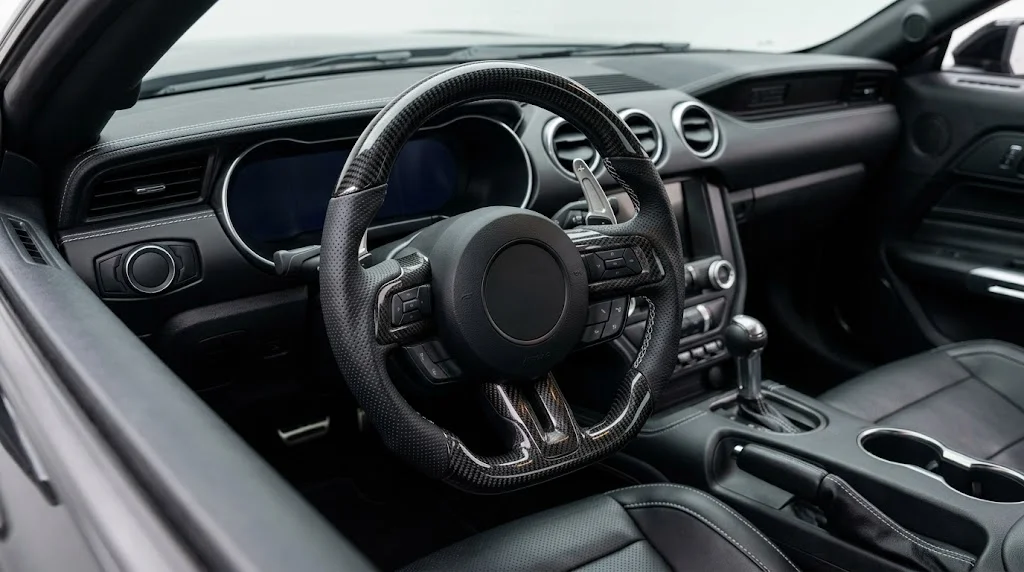
Three families cover most orders we build. The list below sets out what each one gives you.
A daily commute rarely asks much of a paddle. The car shifts for itself, and the paddles matter when you want a lower gear before a slip road.
A Ford paddle shifter upgrade for weekend roads and track days is a different order. An extended alloy paddle keeps the shift under your fingers through a corner, and a firmer click tells you the change has landed.
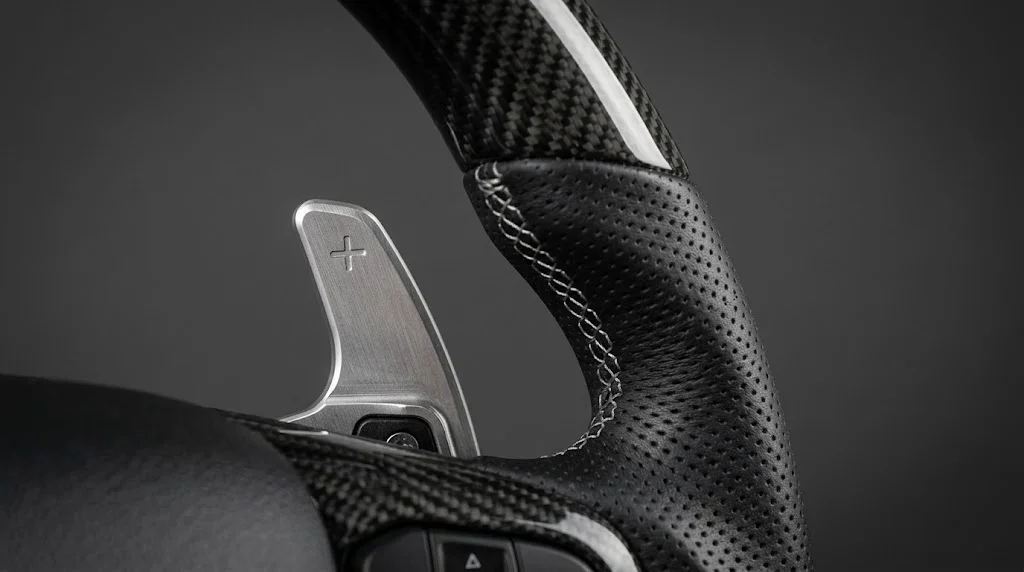
The paddle is a switch, and the wiring already exists on a car that came with paddles. Replacing the paddle itself needs no new loom.
Adding paddles to a car that never had them is a different job. The gearbox control unit has to support manual mode, and the steering column needs the right connector. We check that before quoting, because a paddle that cannot talk to the gearbox is decoration.
A car built without paddles needs the column connector checked as well as the software. If the connector is missing, the job grows beyond a paddle swap, and we will say so before any money is spent.
Four items answer almost every question. Send the model, the year and the trim first. Then add a daylight photograph of the wheel face, and one of the rear with the airbag out.
Have these ready before you write to us:
Those images show us the paddle mount, the connector and the frame. Tell us whether the rim is heated as well, because a heated rim changes the parts behind the cover. A Ford paddle shifter upgrade is only as good as the fitment check behind it.
The mount photograph is the one item we cannot do without, because paddle shapes differ between years.
The paddle mounts share space with the button pods. Every build reuses the frame and the loom already fitted to your Ford, so the horn, the buttons and the paddles all keep working.
The heating mat and any sensing parts sit behind the rim, so each needs its own photograph. Neither can be judged from the front of the wheel.
Where the paddle mount and the button pod share a screw, the order of assembly matters. The smaller parts go back first, and the paddle last.
Rebuilding your own wheel keeps the electronics exactly as Ford assembled them. The frame, the loom and the mount stay standard, and the new paddles bolt to the same points.
A newly made core is the other option. Your factory wheel stays in the garage, which suits a leased vehicle that has to return to standard. It also lets the paddles be fitted before the wheel ships. The original stays safe in a box until the car returns or is sold.
An airbag sits at the centre of this job, so give the work to someone qualified. Isolate the battery and let the vehicle power down fully before a fastener is loosened. Follow the Ford procedure for your chassis rather than a general guide found online.
Set the module down on something soft and away from the work area. Tighten the centre fastener to the figure in the workshop manual for your vehicle, and treat that number as the only source. Afterwards, drive a short distance and confirm the rim sits centred.
Test every switch, the paddles, and the horn. A warning lamp that stays lit means the vehicle should be read before you drive further.
Warranty questions follow any change of this kind. An aftermarket steering wheel does not automatically void a vehicle warranty under U.S. federal warranty law, but warranty coverage can still depend on whether the modification caused the specific failure being claimed.
Where the factory module, the wiring and the vehicle specific parts are reused, further coding may not be needed. The paddles change and the electronics carry on as before.
A vehicle that gains a function it never had is the other case. The control unit may then need to learn what is present, and a workshop visit becomes likely. Coding is a possible step rather than a certainty, and your vehicle decides the answer.
Three issues come up most often on these builds. A paddle from another year carries a different mount and will not sit flush. A wheel with a heated rim packs the matting where the paddle mount needs clearance. A manual car has no manual mode to switch into.
Frame differences are the fourth issue. A wheel from another trim can share the badge and carry a different button frame. That is why the fitment check happens before the order rather than after.
Start the car, select drive and pull each paddle in turn. The gearbox should drop a ratio on the left and raise one on the right, with the change showing on the cluster.
Check the paddle in manual mode as well, and confirm the return to automatic works as it did before. A paddle that clicks but does nothing is usually a connector that is not seated.
Repeat the test with the wheel turned, because the loom takes a different path at full lock. A paddle that works straight ahead and fails at a quarter turn is telling you about the wiring.
No. It varies by model, year and trim, which is why we ask for photographs of the wheel before quoting.
Not realistically. The gearbox has no manual mode to control, and the control unit has nothing to switch.
Yes. An alloy paddle gives a firmer click, and an extended shape brings the tip closer to your fingers.
Only for a rebuild. A new core leaves your factory wheel with you, and the paddles can be fitted before shipping.
Yes. The finish can follow the stitching or the exterior paint, and that choice is part of the same Ford paddle shifter upgrade conversation.
They will. The frame and the loom are reused, so the horn and the spoke buttons behave exactly as before.
Ten to fifteen working days in production, then fifteen to twenty days for shipping. Expect twenty-five to thirty-five days from order to delivery.
Our workshop in Guangzhou is factory-direct, and every rim is made after an order arrives rather than pulled from a shelf. Thirteen or more years of design, engineering and precision manufacturing sit behind the patterns we hold. The paddle mount is checked against your chassis before the first cut.
Material, stitch and shape stay your decisions. Orders ship tracked worldwide with a three-year warranty and thirty days for returns via an RMA request. The team that answers your questions is the team that builds the wheel.
Two guides answer what owners ask next. The Mustang, F-150 and Raptor guide covers the trims and their frames. The heated retrofit guide explains what changes when warmth is added to the rim.
The full range sits in the shop, and the Ford pages are Ford fitment, the Mustang listing and the Focus listing.
Start with the vehicle and the gearbox, then add the year, the option list and the two photographs. We will reply with a confirmed build and a date before work starts on your Ford paddle shifter upgrade.
Two catalogue entries suit these vehicles. The first is the Mustang wheel listed for the 2015 to 2023 cars. The second is the D-type forged carbon wheel for the Focus, supplied with its button frame. Both can be built with the paddle mount your car needs.
For background reading, the installation guide covers the battery and airbag sequence, and the FAQ collects the questions owners raise most. The about page describes the workshop, and fitment or delivery questions can go to the contact page. Lead times are listed in the shipping policy, and returns fall under the return and refund policy. The Magnuson-Moss Warranty Act sets the federal minimum standards, and 16 CFR Part 700 carries the related interpretations. Questions about paddles can go through the inquiry form.
A workshop routine for a Ford rim in Alcantara and carbon fiber: brush, damp wipe, blot and dry, plus the cleaners that quietly ruin a pile or a satin clear coat.
Read More →How to measure a Ford steering wheel at home: the three figures we need, where to place the tape, and the photographs that settle the fitment check before an order.
Read More →How a flat bottom and a round rim differ on a Ford: which shape suits an F-150, Raptor, Mustang, Focus or Bronco, and what each one changes at the wheel.
Read More →